Every business hits a rough patch at some point.
A key customer leaves. A large receivable goes unpaid. Margins compress faster than prices can adjust. A growth investment takes longer to pay back than planned. Sometimes it is a single event; more often it is a combination of several smaller ones arriving at the same time.
It is usually a hard time for everyone, but it is not the time to lose faith or give up quickly. What matters is how quickly the difficulty is recognized and how deliberately it is managed. Businesses that respond early, with clear information and a plan, usually come through. Businesses that wait, hoping things will turn on their own, often lose the options they once had.
This post is about what to do, and in what order.
Step One: Recognize It Early
Most financial difficulties do not arise suddenly. They build, and the signals are usually visible well before the crisis if someone is looking at the right numbers.
The early warning signs we see most often:
Cash is tighter than profit suggests. The business reports a profit, but the bank balance keeps shrinking.
Receivables are stretching. Customers are paying later, and the gap between sales and cash collected is widening.
You are leaning on your line of credit more often, or for longer. A revolver that was used occasionally is now permanently drawn.
Payables are creeping out. You are quietly paying suppliers later to manage cash. This is a warning sign in its own right, and suppliers notice.
Margins are eroding. Gross margin has slipped for several consecutive months with no clear explanation.
Covenant headroom is shrinking. You are getting closer to a limit in your lending agreement.
Decisions are being made with old information. Nobody is sure where the business stands.
If two or three of these are present, you are not in a crisis, but you are in the window where action is cheapest and most effective.
Step Two: Get the Facts, Starting With Cash
When things get difficult, the instinct is to act quickly. The better instinct is to get accurate information first, because decisions made on a hunch in a stressful moment are rarely good ones.
The most important tool is a 13-week cash flow forecast: a week-by-week view of cash coming in and going out over the next quarter. It shows you exactly when cash gets tight, how tight, and how much runway you have. It also tells you which problems are urgent and which only feel urgent. Preparing this in a thoughtful manner is important. Very often we see business owners trying to do this, but it is an afterthought more than an actual exercise to understand the situation, becoming unreliable.
Alongside the forecast, get clear answers to three questions:
What is actually driving the problem? Revenue, margin, working capital, or a one-off event? How you address the problem obviously depends on what it is.
Is it temporary or structural? A delayed payment from a large customer is a timing issue. A permanent loss of a major contract is a structural one. Recognizing this is key, because if you use actions that respond to the wrong problem structure, you may make it worse.
What does business look like in three scenarios? Scenario planning is a very powerful risk management tool. Our view is usually about trying to figure out where the inflection point is. For example, a downside scenario may tell us that the business is in trouble if revenues drop 40%. But we knew that implicitly. A stronger scenario analysis will tell us that by reaching a 27.5% revenue drop, we are going to be in trouble. We now know the inflection point on the downside.
Step Three: Pull the Levers You Control
With the facts in hand, start with the actions that are within your control and that preserve the most value.
Working capital
This is usually the fastest source of cash. Tighten collections, invoice promptly, follow up on overdue accounts, and review payment terms with customers. On the other side, negotiate supplier terms rather than simply paying late. A proactive conversation preserves the relationship; a quiet delay damages it.
Costs
Separate costs into those that protect the business's ability to earn revenue and those that don't. Cutting indiscriminately, especially in sales, customer service, or key people, can deepen the problem. And if the problem is temporary and you cut revenue-generating costs, you risk making a costly mistake.
Pricing and mix
A rough patch is a good moment to look honestly at which products, services, and clients are profitable. Many businesses discover that a meaningful share of their effort goes to work that generates little margin. Service businesses are especially at risk of not really understanding their clients’ margins. It may feel like winning to add clients, but if you are adding clients at a low, or even negative margin, you are making it worse every day. If your cost structure is fixed, it is very important to understand your margins per client.
Owner decisions
Distributions, owner compensation, and discretionary investments are all levers that only the owner controls. Pausing them early is far better than being forced to later. These decisions must be made consciously, generally with a plan to go back to normal (unless you are operating with excessive distributions or compensation). Otherwise, you risk subsidizing a money-losing business without realizing it.
Step Four: Talk to Your Lender Before You Have To
This is the step most owners delay, and it is the one that most often determines the outcome. It is not easy, but it is very important.
Lenders respond very differently to a business that comes forward early with a plan than to one that surfaces after a covenant breach or a missed payment. The former is a partner managing a challenge. The latter is a problem, and lenders truly do not like problems.
When you approach your lender, come prepared with:
A clear explanation of what happened and why
Current financial information and a good forecast. Your lender will want to make sure they understand how the cash is being spent, where it is going, now and in the future, so they can see how you get back on track
The actions you have already taken
A specific request, whether that is a covenant waiver or reset, a payment holiday, a temporary increase in a facility, or a change in structure. Having identified what, you need to get through the crisis is very important. You will gain a lot of credibility and confidence with your lender.
A bank is far more likely to support a business that has done its homework and has a credible path forward. As we have said elsewhere, the best time to build that relationship is before you need it, but the second-best time is as early as possible in the difficulty.
Step Five: Know Your Financing Options
If internal levers are not enough, there are several external options. Each has trade-offs, and the right one depends on the cause and the duration of the problem.
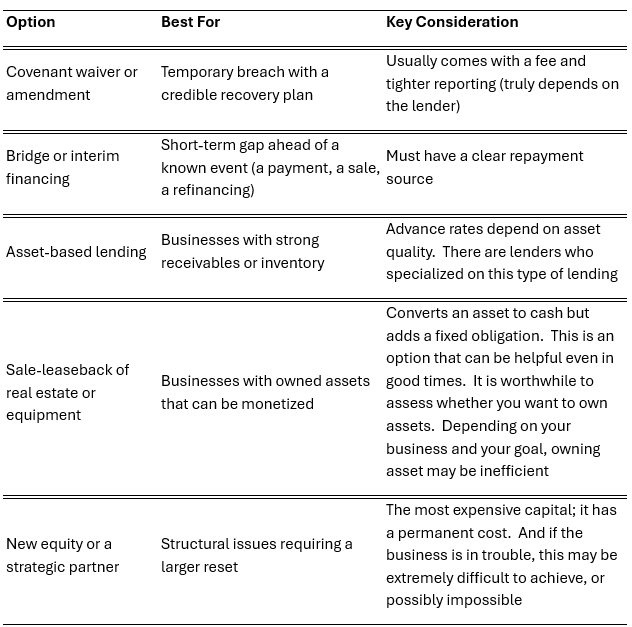
The principle that applies across all of them: the earlier you move, the wider the set of options and the better the terms. A business with six months of runway has more choices than a business with six weeks, and capital providers know it.
Step Six: Communicate, Deliberately
Rough patches are made worse by silence. Employees, key customers, suppliers, and lenders will fill any information gap with their own assumptions, and those assumptions can be far worse than the reality.
You do not need to share everything with everyone, but you do need a considered approach to who needs to know what, and when.
Lenders: early, factual, and with a plan.
Key suppliers: direct and respectful, with a clear proposal on terms.
Employees: honest about the situation and what is being done, without creating unnecessary alarm.
Customers: reassure on continuity of service, without over-explaining internal matters.
You have to be mindful of every conversation. Conversations may be delayed for employees or customers if you know they are not going to feel any impact (for example a temporary large late receivable for which you have a bridge ready with your lender).
Consistency matters. A clear, steady message builds confidence. A shifting story erodes confidence, so it is worthwhile crafting the story appropriately and be confident in the steps forward.
Step Seven: Decide Whether This Is a Turnaround or a Transition
Sometimes the honest conclusion is that the business can recover and return to its previous trajectory. Other times, the better path is a change of ownership, a merger, or a sale while the business still has value.
This is a difficult conversation, and one that owners often avoid until it is forced on them. But a sale or merger from a position of relative strength almost always achieves a better outcome than one from a position of distress.
If a business has structural problems that cannot be fixed with the available time and capital, it is worth exploring strategic options early. Where the situation is serious, it is also important to involve legal counsel and, where appropriate, a licensed insolvency professional, so that you understand your obligations and the full range of restructuring tools available. In some cases, insolvency laws can help you set the business back on track. These are hard decisions to make, but if they are necessary, you need to address them head on.
Step Eight: Bring in Help Sooner Than You Think
Most owners wait too long to seek outside support. The reasons are understandable: cost, pride, or a belief that the situation will resolve itself.
But the value of experienced advisors is highest early in a difficulty. A good advisor helps you build the forecast, stress-test the options, prepare the conversation with your lender, and structure a financing solution, all while you continue to run the business. They also bring something that is hard to find from the inside: perspective, and relationships with lenders and capital providers who know how to work with businesses in transition.
The cost of advice is almost always smaller than the cost of a delayed or poorly executed response.
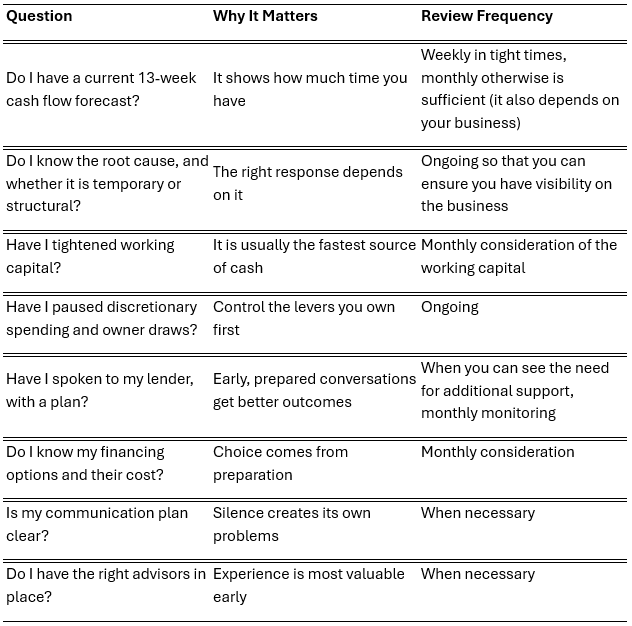
A Practical Checklist
The Bottom Line
A rough patch is not the end of a business. For many companies, it is a defining moment that forces better discipline, clearer information, and sharper decisions.
The pattern we see is consistent. The businesses that come through are not the ones that avoided difficulty. They are the ones that saw it early, got the facts, acted on what they controlled, brought their lenders and advisors in before they had to, and kept their stakeholders informed.
If you are seeing the early signs, now is the time to act. The options you have today will not all be there in three months.
We help business owners navigate difficult periods, from building the cash flow forecast and preparing the lender conversation to structuring financing and exploring strategic options. If you are seeing early warning signs, we would be glad to have that conversation first. Book a call here.