Most business owners have a complicated relationship with their budget.
They put one together at the start of the year and then file it away somewhere it won't bother anyone. By March, it's already out of date. By June, nobody's looking at it.
A budget built the wrong way is not useful at best and misleading at worst. But a budget built the right way is one of the most powerful management tools a business owner can have. Not a compliance exercise, but a live instrument for making better decisions.
This post is about the difference between the two.
Why Most Budgets Don't Work
The typical small business budget is built once, from the top down, based on last year's numbers plus a rough growth assumption. It covers revenue and costs at a high level, gets presented to the bank or the accountant, and then sits untouched until the following year.
The problem isn't the numbers. It's the intent.
A budget built to satisfy an external requirement such as a bank covenant, an investor update, a year-end planning ritual, is fundamentally different from a budget built to run a business. The first is a snapshot. The second is a tool.
The businesses that get real value from their budgets treat them as living documents: tested against actuals and used to drive decisions throughout the year.
What a Good Budget Actually Does
We've been working closely with a client over the past few weeks on a full budget rebuild and the process reinforced something we see consistently: accuracy matters far more than most business owners realize.
Not accuracy in the sense of hitting the numbers exactly. Accuracy in the sense of building a budget that genuinely reflects how the business works: its cost structure, its revenue drivers, its pressure points and its opportunities.
When you get that right, something shifts. The budget stops being a number on a page and starts being a decision-making tool. You can see precisely where performance is tracking ahead of plan and where it's falling behind. You can identify which parts of the business need more investment and which are over-resourced. You can make calls with confidence rather than gut feel.
That's the version of budgeting that changes how a business is run.
The Five Elements of a Budget That Works
1. Build it from the bottom up
Top-down budgets stating "we'll grow 15% this year" are almost always wrong. They start with an outcome and work backwards, which means the assumptions underneath are rarely tested.
Bottom-up budgets start with the actual drivers of your business: How many units will you sell? At what price? With what margin? How many people do you need to deliver that? What does it cost to acquire each customer?
It takes longer to build. But the result is a budget you can actually stand behind because every line has a rationale, not just a number.
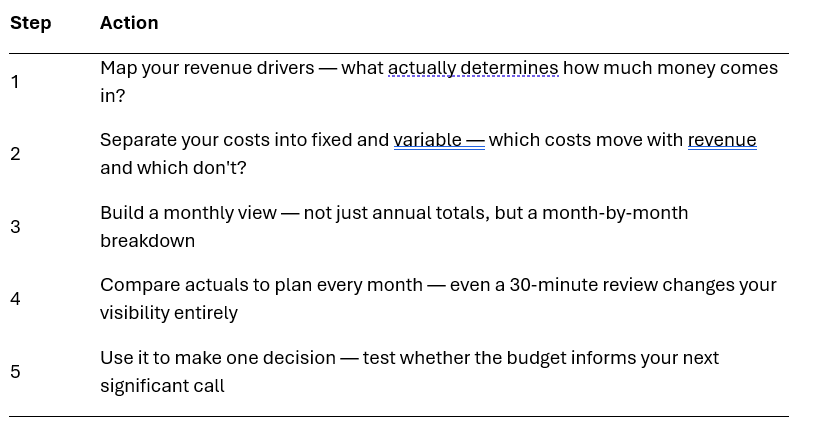
2. Separate fixed and variable costs
One of the most common budgeting mistakes is treating all costs as fixed. In reality, some costs move with revenue and some don't. Understanding that distinction changes how you read your numbers entirely.
When you separate fixed and variable costs properly, you can model what happens to your margins at different levels of revenue. You can see your breakeven point clearly. And you can stress-test the budget against scenarios that matter: what if revenue comes in 20% below plan? What if a key cost increases sharply?
3. Build in a rolling forecast
A static annual budget is a starting point, not a management tool. The businesses that get the most value from their budgets also work with a forecast, which they update, typically monthly. Comparing actuals against budget, and adjusting the forward view as new information comes in.
This is called a rolling forecast, and it's the difference between knowing where you are and knowing where you're going. It doesn't have to be complex. Even a simple monthly review of actuals versus budget, with a forward projection updated for what you now know, gives you a level of financial visibility that most small businesses simply don't have.
4. Make it actionable at the line level
A budget that only tracks revenue and total costs tells you very little. A budget that tracks performance by product, by service line, by team, or by client tells you everything.
The goal is granularity: enough detail that when something goes off track, you can pinpoint exactly where and why. Not so much detail that the budget becomes unmanageable.
Finding that balance is one of the most valuable things a good finance function does. And when you get it right, the budget becomes a diagnostic tool - something you use to run the business better, not just to report on what happened.
5. Connect it to decisions
The ultimate test of a budget is whether it changes how you make decisions.
Are you using it to evaluate whether to hire? To decide whether to launch a new product? To assess whether a new client is profitable enough to pursue? To determine how much cash you need to hold in reserve?
If the answer is no, if the budget sits in a spreadsheet and gets reviewed quarterly at best, it's not doing its job.
The businesses that use their budgets well treat every significant decision as a budget question first. Not because the numbers are always right, but because going through the financial analysis forces clarity that gut feel alone rarely produces.
A Note on Accuracy
One of the things our client work over the past few weeks has reinforced is how much the quality of inputs matters.
A budget built on rough assumptions produces rough insights. A budget built on accurate, granular data produces insights you can actually act on.
The discipline of building an accurate budget is itself valuable, quite apart from the output. It forces you to understand your business at a level of detail that most owners rarely step back to examine. Where are the real cost drivers? Which revenue streams are genuinely profitable? Where are you investing more than you're getting back?
Those questions don't always have comfortable answers. But they're exactly the questions a well-built budget surfaces and the businesses that answer them honestly are the ones that make better decisions.
Start there. A budget doesn't have to be perfect to be useful. It has to be accurate enough to tell you something true about your business and used consistently enough to actually influence how you run it.
We help growing businesses build budgets that work — not just for year-end, but as live management tools. If your current setup isn't giving you the visibility you need, we'd be glad to have that conversation.