Many business owners run their business for years before they truly understand their financial statements.
They glance at the numbers. They know roughly whether things are good or bad. They rely on their accountant to tell them if something is wrong. If there is cash in the bank account, there is no real urgency to understand what is going on. But the actual financials, the income statement, the balance sheet, the cash flow statement, remain somewhere between confusing and intimidating.
Hopefully we will help you understand those better with this post.
Understanding your financial statements is not an accounting exercise. It is really a business skill, one that will make you a better decision-maker, a more credible operator, and a more informed owner of the business you've built.
The Three Financial Statements And What Each One Actually Tells You
Every business produces three core financial statements. Each one answers a different question.
The Income Statement answers: Is my business profitable?
The Balance Sheet answers: What does my business own and owe?
The Cash Flow Statement answers: Where did the cash go?
Most business owners are familiar with the income statement, at least in broad terms. The balance sheet and cash flow statement tend to get less attention. That's a mistake, because the three statements together tell a story that none of them can tell alone.
The Income Statement: Profit and Loss
The income statement which is also called the profit and loss statement or P&L, shows your business's financial performance over a period of time. Typically a month, a quarter, or a year.
It works from top to bottom:
Revenue: the total value of sales or services delivered in the period. This is your top line. It can be useful to break it into components if you sell more than one thing.
Cost of Goods Sold (COGS): the direct costs of delivering those sales. For a product business, this includes materials and direct labour. For a service business, it includes the direct cost of delivering the service.
Gross Profit: Revenue minus COGS. This is the money left over after the direct cost of delivering your product or service. Gross profit divided by revenue gives you your gross margin, one of the most important indicators of your business model's health.
Operating Expenses: the indirect costs of running the business: rent, salaries, marketing, software, insurance, and everything else that isn't directly tied to delivering a specific sale.
Operating Profit (EBIT): Gross Profit minus Operating Expenses. This is what the business earns from its core operations before interest and tax.
Net Profit: the bottom line, after interest costs and taxes are deducted. This is what the business actually earned in the period.
What to look for:
Is gross margin stable, improving, or declining?
Are operating expenses growing faster than revenue?
A business can look healthy from a revenue perspective but be in trouble at the bottom line. Reading the income statement from top to bottom, rather than just looking at net profit, tells you where the pressure is coming from.
The Balance Sheet: A Snapshot in Time
The balance sheet is a snapshot of your business's financial position at a single point in time which is typically the last day of a reporting period.
It is built around a simple, but very fundamental, equation:
Assets = Liabilities + Equity
Everything your business owns (assets) is financed by either money it owes to others (liabilities) or money that belongs to the owners (equity). This equation always balances, hence the name.
Assets are divided into:
Current assets: things that will be converted to cash within twelve months: cash, receivables, inventory, prepaid expenses
Non-current assets: longer-term assets: equipment, property, intangible assets, long-term investments
Liabilities are divided into:
Current liabilities: obligations due within twelve months: accounts payable, short-term debt, accrued expenses
Non-current liabilities: longer-term obligations: bank loans, lease obligations, deferred tax
Equity: what's left after liabilities are subtracted from assets. This represents the owners' stake in the business and accumulates, or declines, over time as profits, or losses, are retained.
What to look for:
Is the business liquid? Compare current assets to current liabilities (this is called the current ratio), if current liabilities exceed current assets, the business may struggle to meet its short-term obligations
Is debt growing relative to equity? A balance sheet that is becoming increasingly leveraged over time deserves attention. It is not necessarily wrong, but it needs to make sense and generally part of the owners’ plan. It certainly should be an area of attention
Are receivables growing faster than revenue? This can signal collection problems or aggressive revenue recognition
The balance sheet is the financial statement that banks and investors look at most carefully. Understanding it is essential for any business conversation involving capital.
The Cash Flow Statement: Following the Money
The cash flow statement is the most overlooked of the three statements, and arguably the most important for a growing business.
It shows where cash came from and where it went during a period. Unlike the income statement, which records revenue when it is earned and expenses when they are incurred, the cash flow statement only cares about actual cash movements.
This distinction matters enormously. A business can be profitable on its income statement and cash-flow-negative at the same time! For example, if customers are slow to pay, if inventory is building up, or if the business is investing heavily in future growth, it may be cash flow negative even if it is profitable.
The cash flow statement is divided into three sections:
Operating cash flow: cash generated or consumed by the core business operations. This is the most important number. A business with consistently positive operating cash flow is generating real value. A business with consistently negative operating cash flow is consuming cash to survive, regardless of what the income statement says.
Investing cash flow: cash spent on or received from investments in long-term assets: buying equipment, acquiring a business, selling a property. Negative investing cash flow is not necessarily bad, it often means the business is investing in its future.
Financing cash flow: cash flows related to debt and equity: borrowing money, repaying loans, paying dividends, issuing shares. This section shows how the business is funding itself.
What to look for:
Is operating cash flow consistently positive?
Is the business generating enough operating cash flow to fund its investing activities without relying entirely on external financing?
Is the gap between net profit and operating cash flow growing? A widening gap often signals working capital problems
How the Three Statements Connect
The three statements are not independent documents. They tell different parts of the same story and connect to each other in specific ways.
Net profit from the income statement flows into equity on the balance sheet via retained earnings which accumulates (or decrease) as the business generates profit (or losses) over time.
The cash flow statement reconciles net profit to actual cash movement. It explains why a profitable business might have less cash than expected, or why a loss-making period didn't result in a cash crisis.
Understanding how the three statements connect transforms them from three separate documents into a single, coherent picture of your business's financial reality.
A Practical Reading Guide
The next time your accountant sends you financial statements, try this:
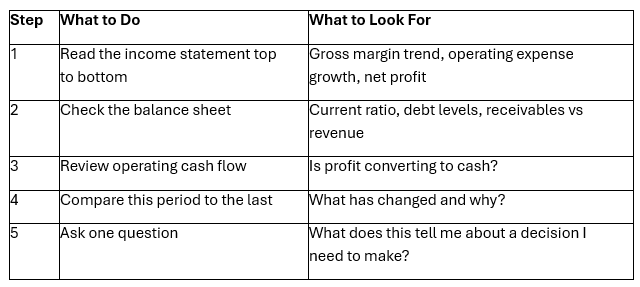
The goal is not to become an accountant. The goal is to be an informed business owner who can read their financial statements, ask the right questions, and make better decisions as a result.
The Bottom Line
Your financial statements are not documents produced for your accountant. They are the most accurate picture available of how your business is performing, where it is strong, and where it is vulnerable.
Business owners who understand their financials make better decisions. They have more credible conversations with their bank. They spot problems earlier. They identify opportunities their competitors miss.
It takes time to build this skill. But it is one of the highest-return investments a business owner can make.
We help business owners understand and use their financial statements as active management tools. If you'd like to get more out of your numbers, we'd be glad to help. Book a call here