It must be an absolute truth that all growing businesses have some form of financial reporting but that very few have good financial reporting.
The difference matters more than most business owners realize. Poor financial reporting doesn't just mean you have less information, it means the information you do have is often wrong, not useful, or presented in a way that makes it impossible to act on.
Good financial reporting is not about producing more documents. It is about having the right information, in the right format, at the right time and using it to run the business better. Actionability is much more important than quantity
Here is what that actually looks like in practice.
What Financial Reporting Is Actually For
Before getting into what good reporting looks like, it is worth being clear about what it is for.
Financial reporting serves two distinct purposes:
The first is external: satisfying the requirements of your bank, your investors, and the tax authorities. In some cases, there are a few other stakeholders, such as a union or perhaps a specific client or supplier. This is compliance reporting. It needs to be accurate and timely, but it is fundamentally backwards-looking and designed for an audience outside the business.
The second is internal: giving you and your management team the information you need to make better decisions. This is management reporting. It is the version that really helps you to run the business.
Most small and growing businesses invest heavily in compliance reporting and almost nothing in management reporting. The result is a business that can satisfy its stakeholders but cannot answer basic questions about its own performance.
The goal of good financial reporting is to fix that imbalance.
The Three Qualities of Good Financial Reporting
1. Timely
Financial information has a shelf life. A management report that arrives too late is not a management tool. It provides historical information that is interesting but tends to be less helpful.
Good financial reporting is fast. Monthly management accounts should be ready rapidly. For fast-moving businesses, weekly cash flow updates and key metric snapshots are worth building into the rhythm.
The businesses that make the best decisions are the ones that know where they stand now.
Note: There is a cost to speed. It is important to make the reporting cycle a key component of the month end and ensuring that it is effective.
2. Accurate
Speed without accuracy is worse than useless. A management report that arrives quickly but contains errors, inconsistencies, or poorly allocated costs will lead to bad decisions made with confidence (this is the most dangerous kind).
Accuracy in financial reporting requires clean underlying data: properly coded transactions, consistent accounting treatment, and a chart of accounts that reflects how the business actually operates. These foundations are worth investing in early as they are very difficult to fix retrospectively.
3. Actionable
The test of a financial report is not whether it contains information. It is whether it changes what you do.
A report that summarizes what happened without telling you why, or without connecting the numbers to decisions you need to make, is not actionable. Good financial reporting is designed around the questions the business needs to answer and not around what is easy to produce.
What a Good Monthly Management Pack Looks Like
For most growing SMEs, the core of good financial reporting is a monthly management pack. Here is what it should contain:
Executive summary
A brief narrative that tells the story of the month. What happened, why, and what it means going forward. This is the most important page in the pack and the one most management packs leave out entirely.
We like to think about Management Speak: They won’t read the whole thing, what is the 2 to 3 bullets they need to know? The first page gives you that information easily.
Income statement: actual vs budget vs prior year
Not just the numbers, but the variance. What was different from plan, and why? A three-column income statement that shows actuals, budget, and prior year side by side tells a much richer story than actuals alone. We like to also have the differences between actual and budget as some variances are less material so honing on the most material items is helpful.
Gross margin analysis
Broken down by product, service line, or client where possible. This is the section that most often reveals where the business is actually making money.
Breaking down gross margin is extremely powerful. Assessing how best to track it is also important to manage in the best possible way.
Cash flow statement and cash position
Where did the cash go this month? What is the current cash position? What does the next four to eight weeks look like? Cash is the lifeblood of the business and should be reported on every month without exception.
Balance sheet
A snapshot of the business's financial position at month end. Particular attention to receivables, are they growing relative to revenue? And to current liabilities, are short-term obligations being managed carefully?
Key metrics dashboard
Four to six metrics that matter most for your specific business. These vary by industry and business model but typically include gross margin percentage, revenue per employee, and one or two operational metrics specific to your business.
Choose wisely: too much information is not necessarily helpful and can create more noise than necessary.
Rolling forecast
An updated view of where the business is heading for the remainder of the year, incorporating what you now know. This is what separates a reporting pack from a management tool, the forward view is as important as the backward one.
The Reporting Cadence
A reporting cadence that works for most growing SMEs looks like this:
Frequency
What
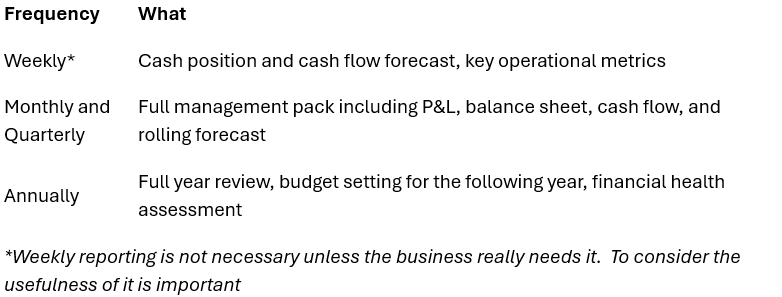
The weekly rhythm keeps cash visible and operational issues surfaced early. The monthly pack provides the full picture. The quarterly review can help taking a step back. The annual process sets the direction.
Most businesses only do the annual. Some do the monthly or quarterly. Monthly is an absolute must for management.
Common Reporting Failures
No narrative, just numbers Numbers without context are not information. A management pack that presents columns of figures without explaining what happened and why forces the reader to draw their own conclusions, which are often wrong.
Chart of accounts that doesn't reflect the business If your accounting system groups costs in ways that don't match how you think about the business, your reporting will always feel disconnected from reality. Investing in a properly structured chart of accounts is one of the highest-return technical improvements a growing business can make.
Reporting that looks backwards only A management pack that tells you what happened last month without any view of where the business is heading is only half the picture. The forward view (the rolling forecast) is what makes financial reporting a management tool rather than a historical record.
Metrics that don't connect to decisions If your reporting includes metrics that nobody acts on, they are wasting space and attention. Every metric in your management pack should connect to a decision someone in the business needs to make.
Who Should Own Financial Reporting
Someone needs to own the reporting: to set the standards, ensure the data is clean, produce the pack on time, and present it in a way that drives action.
In a small business, this is often the owner. An owner who is also responsible for producing the financial reporting will always deprioritize it in favor of running the business. The reporting gets late, then gets skipped, then becomes an annual exercise.
The businesses that get financial reporting right have someone whose job it is to make sure it happens, whether that is a finance manager, a controller, or a fractional CFO who owns the reporting rhythm and holds the business accountable to it.
The Bottom Line
Good financial reporting is not a nice-to-have. It is one of the most important operational investments a growing business can make.
The businesses that know their numbers, really know them, in real time, with the right context, make better decisions, spot problems earlier, and build more resilient organizations than those running on instinct and quarterly summaries.
If your current financial reporting doesn't tell you clearly where your business stands, where it is going, and what you need to do about it, that is worth fixing.
We help growing businesses build financial reporting that works from designing the management pack to owning the monthly rhythm. If your reporting isn't giving you the visibility you need, we'd be glad to help.