Debt is more complex than ever. It is a good thing as it now offers many more options to businesses. Each type is designed for a different purpose, with different costs, risks, and conditions attached.
Choosing the wrong one can be expensive, even when the interest rate looks attractive. A loan that is perfectly priced but structured for the wrong need can strain your cash flow, restrict your flexibility, or leave you refinancing at the worst possible moment.
This post is a practical guide to the main types of business debt, what each is for, and how to think about choosing between them. It builds on our earlier overview in our lender series, Understanding Your Financing Options, and goes deeper on how to choose.
The Principle That Guides Everything: Match the Debt to the Need
Before looking at specific products, one principle is worth keeping in mind.
The best debt is the one whose structure matches what the money is being used for.
Short-term, fluctuating needs, such as funding the gap between paying suppliers and collecting from customers, call for short-term, flexible debt.
Long-term assets, such as equipment, property, or an acquisition, call for longer-term debt that can be repaid from the cash flow those assets generate.
Situations that don't fit a standard box, such as a complex transaction or a temporary dip in performance, may call for more specialized capital.
Most financing problems we see are not caused by borrowing too much. They are caused by borrowing the wrong type of debt for the purpose.
The Main Types of Business Debt
1. Term Loans (Cash Flow Loans)
A term loan provides a lump sum up front, repaid over a fixed period through regular payments of principal and interest.
Best for: defined investments with a clear payback, such as cashflow linked equipment or property, a fit-out, an expansion, or a smaller acquisition.
What to know: Rates may be fixed or floating, and the repayment schedule creates a predictable obligation. Lenders will typically take security over business assets and may ask for personal guarantees (personal guarantees are hard to avoid for small businesses). Make sure the term matches the useful life of what you are funding, if available from the lender of course. If you need a long period of time, you can roll the debt over shorter maturities to equate longer term loan.
2. Revolving Credit Facilities (Lines of Credit)
A revolving facility gives you access to a maximum amount that you can draw, repay, and draw again. You pay interest only on what you use, and often a fee on the unused portion.
Best for: working capital, meaning the day-to-day timing gaps between cash going out and cash coming in.
What to know: Revolvers are designed to be used and repaid, not to sit permanently drawn. A revolver that never goes back to zero is often a sign it is funding something longer term, which is a structural problem. Facilities are often tied to a borrowing base (a percentage of receivables and inventory), and banks can review or reduce them, so they are not guaranteed liquidity in difficult times.
3. Asset-Based Lending (ABL)
With asset-based lending, the amount you can borrow is determined by the value of specific assets, typically receivables, inventory, and sometimes equipment.
Best for: businesses with strong, high-quality assets but earnings that are thin, volatile, or in transition. It is also useful for fast-growing businesses whose working capital needs outpace what a traditional bank will lend.
What to know: The lender focuses on collateral quality rather than just cash flow. This can unlock capital that a conventional bank would decline, but it typically involves tighter monitoring and reporting, such as regular borrowing base certificates. Specialized lenders operate in this area.
4. Invoice Financing and Factoring
Another type of ABL, invoice financing, allows you to borrow against outstanding invoices. In factoring, you sell the invoices to a third party at a discount in exchange for immediate cash.
Best for: businesses with long payment cycles and creditworthy customers.
What to know: It is typically more expensive than a bank line, and in some forms your customers are notified. It can be a useful bridge, but it is rarely the cheapest long-term solution.
5. Equipment Financing and Leasing
Here the equipment itself serves as the security. You either borrow to buy it or lease it for a period, sometimes with an option to buy at the end.
Best for: acquiring vehicles, machinery, technology, or other specialized equipment without tying up other credit.
What to know: Because the asset is the collateral, these facilities can be easier to obtain and keep your main credit lines free. Compare the total cost, not only the monthly payment, and understand what happens at the end of the lease.
6. Commercial Mortgages
A long-term loan secured by real estate, usually with a longer amortization than other business debt.
Best for: acquiring or refinancing owned property.
What to know: Longer amortizations mean lower payments but more interest over time. A useful question is whether owning the property is the best use of your capital, or whether a lease would leave more capital for growing the business.
7. Government-Backed and Program Loans
Many jurisdictions offer loan programs in which the government shares part of the lender's risk, making it easier for smaller businesses to access financing. Others offer targeted funding for specific activities such as innovation, exports, or hiring.
Best for: smaller businesses or specific projects that fall within program criteria.
What to know: These can offer attractive terms but come with eligibility requirements, caps, and paperwork. Programs and terms change, so it is worth checking what is currently available before you assume it fits.
8. Subordinated and Mezzanine Debt
This type of debt ranks behind senior lenders in the event of repayment problems, so lenders charge more for the additional risk. It often combines cash interest with deferred or "payment-in-kind" interest, and sometimes an equity component such as warrants.
Best for: financing growth, acquisitions, or ownership transitions when senior debt alone is not enough and you want to avoid giving up too much equity.
What to know: More expensive than senior debt but often cheaper than equity, and it can fill the gap between the two. It needs to be carefully structured so that total leverage remains manageable.
9. Private Credit and Direct Lending
Non-bank lenders, funded by institutional investors, provide loans directly to businesses. Structures range from senior term loans to unitranche facilities (a single blended loan) to more tailored solutions.
Best for: transactions or situations that a bank cannot underwrite, or where speed, certainty, and flexibility matter more than the lowest possible rate. Examples include acquisitions, recapitalizations, complex balance sheets, and businesses in transition.
What to know: Pricing is typically higher than bank debt, but terms can be more flexible and the process faster. Lenders in this market vary considerably, so knowing which ones fit your situation matters as much as the terms themselves.
10. Bridge Loans
Short-term financing to cover a gap until a known event occurs, such as a sale, a refinancing, or a receivable being collected.
Best for: well-defined, temporary needs.
What to know: It must have a clear and credible repayment source. A bridge with no exit is not a bridge, it is a problem on a timer.
11. Vendor Take-Back Financing
In an acquisition, the seller agrees to defer part of the purchase price, which is then repaid over time.
Best for: acquisitions where the buyer's financing is stretched or where the seller wants to demonstrate confidence in the business's future.
What to know: It reduces the upfront capital required and aligns the seller's interests with the buyer's success, but it must be properly documented and coordinated with senior lenders, who will often require it to be subordinated.
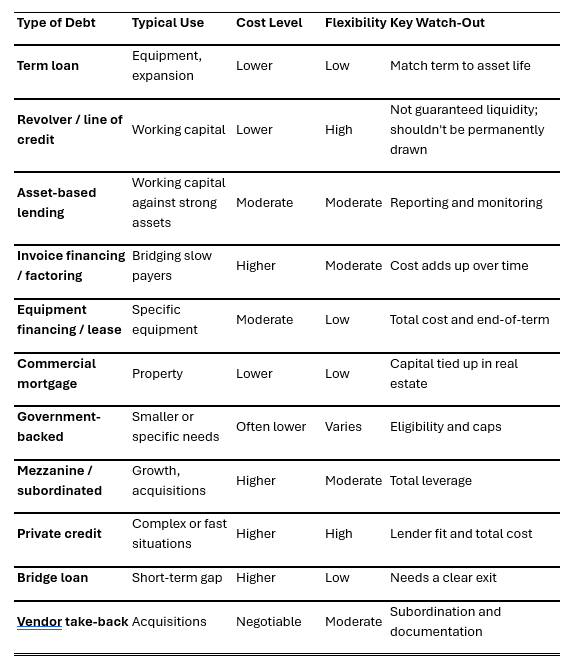
A Quick Comparison
What Else Matters Beyond the Rate
The interest rate is the most visible part of a loan, and not always the most important. When comparing options, look closely at:
Security and guarantees. What assets are pledged? Are personal guarantees required? As a reminder, a personal guarantee undermines the separation between you and the company, which is one of the main reasons to incorporate. They are often hard to avoid, but they should be a conscious decision and, where possible, limited in scope or time. We covered collateral in more detail in an earlier post in our lender series.
Covenants. What financial tests must you meet, and how much headroom do you have? A tight covenant on a low-rate loan can be more expensive than a higher-rate loan with room to breathe.
Fees. Arrangement fees, standby fees, prepayment penalties, and monitoring costs all affect the real cost.
Repayment profile. How much cash does the structure require each month, and can your business service it through a downturn, not just in a good year?
Flexibility. Can you prepay, redraw, extend, or amend if circumstances change?
The lender relationship. Some lenders will work with you through a difficult period. Others will not. This is hard to see on a term sheet but matters a great deal when conditions change.
How to Choose
A simple way to approach the decision:
Define the need clearly. How much, for what purpose, over what period, and what will repay it?
Match the structure to the purpose. Short-term needs with short-term debt, long-term assets with long-term debt.
Stress-test the repayment. Model the debt service under your base case and under a downside, and be honest about what the business can absorb. For how much debt is the right amount, and how to balance cost against risk, see our earlier post, Capital Structure: Balancing Risk and Cost.
Compare total cost and terms, not just the headline rate.
Consider the full set of options, not only the one your bank offers first. Different lenders have different appetites, and the best fit is often not the default one.
Think about what comes next. Will this structure still work if the business doubles in size, or if you need to raise additional capital?
Another consideration is if you are operating under an optimal leverage ratio. Optimizing your capital structure may not be instrument dependent. Consider not only the necessary instrument but the necessary leverage in what you are financing.
How Much Debt Is the Right Amount?
Debt is usually cheaper than equity. Interest is generally tax-deductible, the cost is fixed, and lenders do not share in the upside of the business. So, up to a point, replacing some equity with debt lowers your overall cost of capital, the blended cost of all the money funding the business.
But the benefit does not continue indefinitely. As debt increases, the risk of financial distress rises. Lenders charge more for additional borrowing, and equity holders demand a higher return because their position becomes riskier. Eventually, the added cost of both outweighs the benefit of cheaper debt.
The result is a U-shaped curve: the cost of capital falls as you add debt, reaches a low point, then rises again. The debt ratio at the low point is the optimal debt ratio, the mix that minimizes your cost of capital.
Here is a simplified illustration. These numbers are for illustration only, and every business's curve is different:
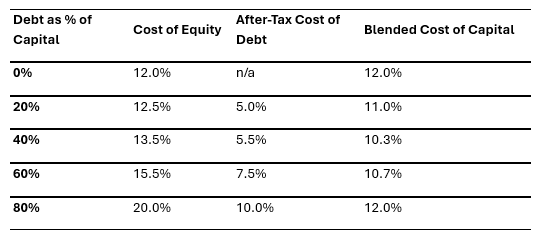
In this example, the lowest blended cost of capital is around 40% debt. Going beyond that makes both debt and equity more expensive, and the business pays more for its capital, not less.
A few points of caution when applying this to a real business:
The optimum is a range, not a single number. The curve is usually flat near the bottom, so a ratio somewhat above or below the minimum costs very little.
Theory is a ceiling, not a target. The theoretical optimum assumes you can comfortably service the debt at all times. Real businesses face volatile cash flows, covenants, and downturns. Most SMEs are better off operating below their theoretical optimum to preserve headroom and flexibility.
It depends on your business. Stable, predictable cash flows and strong, tangible assets can support more debt than cyclical or asset-light businesses.
Lenders set practical limits. Covenants and lending criteria will often cap leverage well before the theoretical optimum is reached.
The goal is not necessarily to find a precise number but to understand the trade-off, so that your borrowing decisions are deliberate. We cover this balance, and the metrics to track, in more detail in Capital Structure: Balancing Risk and Cost.
The Role of an Advisor
An advisor helps you define the need, structure the request, prepare the financial story, approach the right set of lenders, and negotiate terms. The value is not simply access to lenders. It is knowing which lenders are likely to say yes, on what terms, and how to present your business so that they do.
In practice, the difference between a well-run financing process and an unadvised one shows up in the structure: better covenants, more suitable repayment profiles, fewer surprises, and often a lower overall cost of capital, even when the headline rate is not the lowest.
The Bottom Line
Debt is a tool, and like any tool, it works best when it is the right one for the job. A well-chosen facility supports growth and resilience. A poorly chosen one, even if it looks cheap, can quietly constrain the business for years.
Before you borrow, be clear about what you need the money to do, understand the full range of options available, and look beyond the rate. The structure matters as much as the price.
We help SME leaders define their financing needs, compare their options, and secure the right debt on the right terms, from bank facilities to private credit. If a financing decision is on your horizon, we would be glad to have that conversation first. Book a call here.