The bookkeeper is keeping up with the transactions. The accountant files the returns. But nobody is actually managing the finances: thinking ahead, flagging problems early, helping you make better decisions with better information.
You know you need someone. You're just not sure who, when, or what that person should actually do.
This post is about answering those three questions clearly.
The Mistake Most Business Owners Make
The most common mistake is hiring too late and also hiring the wrong person.
A business that has outgrown its bookkeeper for eighteen months finally hits a crisis: a cash flow shock, a bank conversation that doesn't go well, a pricing decision that turns out to have been wrong for years. Under pressure, the owner hires quickly and often ends up with someone who can record transactions faster, rather than someone who can prevent the next crisis from happening.
The second most common mistake is hiring too early in the wrong way such as bringing on a full-time finance hire before the business genuinely needs one, at a cost that doesn't make sense for the stage of the business.
Getting this right means understanding what you actually need, when you need it, and what form that support should take.
When Is the Right Time?
There is no universal revenue threshold or headcount trigger. The right time to bring in proper finance support is when the complexity of your business has outgrown the simplicity of your current setup.
In practice, that moment tends to arrive when several of these are true simultaneously:
You're making significant decisions without confidence. Hiring, pricing, expansion, new product lines. These decisions are being made on gut feel because the financial information to support them either doesn't exist or isn't being surfaced clearly.
Cash flow is unpredictable. You've been surprised by your cash position either running lower than expected or not understanding why a profitable month left you short. Nobody is actively managing the timing of inflows and outflows.
You don't know your margins by product, service or client. You know the overall numbers roughly, but you can't tell which parts of the business are profitable and which aren't. That information exists somewhere but it's just not being used.
You're approaching a significant moment. A financing conversation, a potential acquisition, a key hire, a pricing overhaul. Any of these require financial rigor that your current setup can't provide.
Your bank or investors are asking questions you can't answer. If you're scrambling to pull together information that should be readily available, that's a clear signal.
If two or three of these feel familiar, you're probably at the threshold. If four or more resonate, you're likely already past it.
What Should This Person Actually Do?
This is where most business owners get confused because "finance person" covers an enormous range of roles, capabilities, and costs.
Here's a simple way to think about it. Finance work falls into three broad levels:
Level 1 — Recording Bookkeeping, accounts payable and receivable, bank reconciliations, payroll processing. This is transactional work. It needs to be done accurately and on time. It does not require seniority, and it should not be expensive too expensive.
Level 2 — Reporting Management accounts, monthly financial summaries, variance analysis, basic financial modelling. This is the work of turning records into information, giving you a clear picture of where the business stands and how it's performing against plan.
Level 3 — Advising Cash flow forecasting, budgeting and planning, pricing analysis, capital structure, banking relationships, scenario modelling, strategic financial input. This is where finance becomes a management tool rather than a compliance function and it starts to actively improve the decisions you make.
Most growing businesses that feel the need for finance support actually need Level 2 and Level 3. What they often hire is more Level 1.
The question to ask before you hire is: what level of finance work does my business actually need right now and what am I currently missing?
The Options
Once you know what you need, you have several ways to get it:
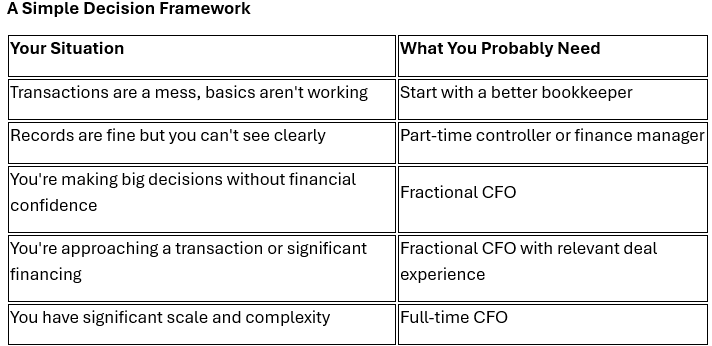
A bookkeeper: right for Level 1 work. Relatively low cost, widely available, straightforward to manage. If your current bookkeeper is good and your problem is at Level 2 or 3, adding another bookkeeper solves nothing.
A part-time controller or finance manager: right for businesses that need solid Level 2 work but aren't ready for senior strategic input. Typically hired on a part-time or contract basis. Can build and manage your reporting, clean up your financial processes, and give you a clearer picture of the business.
A fractional CFO: right for businesses that need Level 3 input without the cost of a full-time senior hire. A fractional CFO brings strategic finance capability: planning, capital, banking, M&A readiness, pricing, on a part-time basis. This is the model that makes most sense for growing SMEs that have outgrown their bookkeeper but aren't large enough to justify a full-time CFO.
A full-time CFO: right for businesses of significant scale, complexity, or those approaching a major transaction. The cost is substantial, typically $200,000+ in total compensation and the role only makes sense when the volume and complexity of financial work genuinely justifies it.
For most businesses reading this, the answer is either a part-time controller or a fractional CFO, depending on whether the gap is primarily in reporting or in strategic financial leadership.
What to Look For
Regardless of which model you choose, a few things matter in any finance hire:
They speak plainly. The best finance people make complex things simple. If a candidate can't explain your cash flow position in plain language, they won't be useful to you as a business owner.
They're proactive, not reactive. You want someone who flags issues before they become problems, not someone who shows up with the bad news after it's already happened.
They understand your business, not just your numbers. Finance people who only look at spreadsheets and don't engage with the operational reality of the business tend to give advice that doesn't land. The best ones are curious about how the business actually works.
They have relevant experience. A fractional CFO who has worked with businesses at your stage and in your sector will get up to speed faster and add value sooner than a generalist who needs to learn your world from scratch.
The Cost Question
The honest answer is that good finance support costs money and the right way to think about it is not as an overhead but as an investment.
A fractional CFO who helps you identify a pricing gap, avoid a cash flow crisis, or structure a financing conversation correctly will almost always deliver a return that significantly exceeds their fee. The businesses that resist bringing in finance support on cost grounds are often the ones that pay far more in missed opportunities, poor decisions, and problems that could have been avoided.
The question isn't whether you can afford good financial leadership. It's whether you can afford not to have it.
A Simple Decision Framework
The Bottom Line
The right time to bring in finance support is before you need it not after the crisis has arrived.
And the right hire is the one that fills the actual gap in your business: not more transaction processing if your problem is strategic, and not an expensive full-time hire if a fractional model delivers everything you need at a fraction of the cost.
Getting this decision right is one of the highest-leverage moves a growing business can make. The businesses that do it well grow faster, make better decisions, and build something more resilient than the ones that stay too long with a setup that has stopped serving them.
We work with growing businesses at exactly this inflection point as fractional CFOs and financial advisors who help owners build the finance function their business actually needs. If you're wondering whether your current setup is right for where you're going, we'd be glad to have that conversation.