Most growing businesses hit the same wall at some point.
The numbers are being recorded. The bank reconciliation gets done. The invoices go out and the bills get paid. On paper, everything looks fine.
But then you're sitting across from your bank manager, or a potential investor, or just trying to decide whether you can afford to hire someone — and you realize you don't actually know if your business is profitable. Not really. Not in a way that helps you make a decision.
That's not a bookkeeping problem. That's a finance problem. And it's one of the most common, and most costly, gaps in growing businesses.
This post explains the difference between what a bookkeeper does and what a finance function actually needs to do, the warning signs that you've outgrown your current setup, and what good financial leadership looks like at your stage of growth.
What a Bookkeeper Actually Does
Let's be clear: bookkeepers are extremely valuable and absolutely necessary. A good bookkeeper keeps your records clean, your accounts reconciled, and your basic financial statements in order. That's important work and without it, everything else falls apart.
But bookkeeping is recording what happened. It is not analysis, interpretation, or advice. It is not forecasting or planning. It is not telling you what your numbers mean or what you should do next.
A good bookkeeper answers the question: what did happen?
A finance function answers the question: what should we do?
Those are very different questions and one of them helps you optimize your business outcomes.
The Three Questions Your Bookkeeper Can't Answer
Here are the three questions that matter most to a growing business — and that a bookkeeper, by definition, is not equipped to answer.
1. Are we actually profitable?
Your profit and loss statement shows revenue minus expenses. But that number can be misleading without context. Are your margins improving or deteriorating? Which products or services make money and which don't? What is your true cost to serve a customer? A bookkeeper records the numbers. A finance function interprets them. It is also extremely important to ensure that your bookkeeper prepares financial information on an accrual basis. That is one of the biggest gap in understanding true profitability!
2. Can we afford to do this?
Whether 'this' is hiring a new employee, investing in equipment, taking on a big new contract, or expanding into a new market, the answer requires a forward-looking financial view. Cash flow forecasting, scenario modelling, and an understanding of your working capital cycle. None of this is in scope for a bookkeeper.
3. Where is this business going?
Investors, banks, and sophisticated buyers want to understand your financial trajectory not just your historical results. Building a credible financial model that shows where the business is going, and why, requires financial expertise that goes well beyond recording transactions.
The Warning Signs You've Outgrown Your Bookkeeper
Most business owners don't realize they've outgrown their bookkeeper until something goes wrong. Here are the signs to watch for earlier:
• You can't answer basic questions about your margins without digging through spreadsheets
• You've been surprised by a cash shortfall despite showing a profit
• You're making hiring, pricing, or investment decisions based on gut feel rather than financial analysis
• Your bank or an investor has asked for financial information you couldn't produce quickly
• You're spending significant time on financial admin that isn't giving you useful information
• You don't have a budget for the year or if you do, you're not tracking against it
• Nobody in your business is thinking about financial risk before it becomes a problem
If any of these feel familiar, it doesn't mean your bookkeeper is doing a bad job. It means your business has grown to a point where you need more than bookkeeping.
Bookkeeper vs. Fractional CFO — What's the Difference?
Here's a practical comparison of what each brings to your business (we are not adding controller in this chart, but anyone intrigued by the controller role can reach out for explanation):
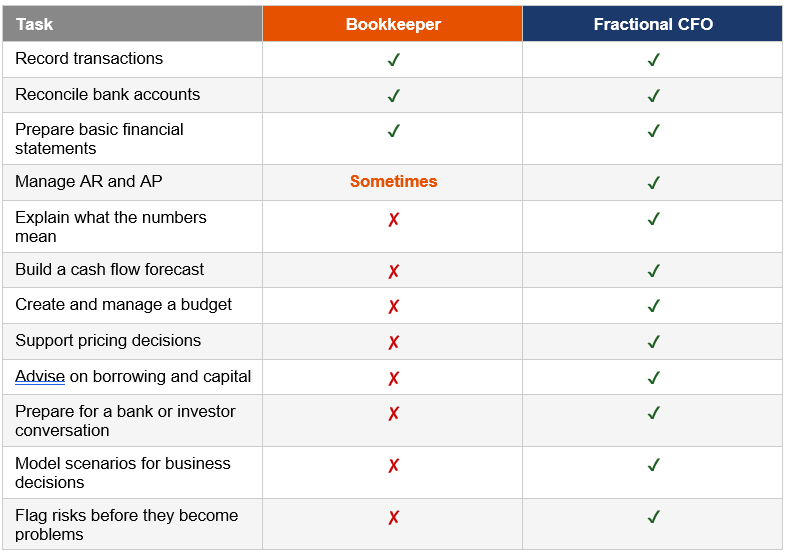
What Good Financial Leadership Looks Like at Your Stage
For a growing business that isn't ready for or doesn't need a full-time CFO, a fractional CFO provides the same strategic financial leadership at a fraction of the cost.
In practice, that means:
• Monthly management accounts that actually tell you how your business is performing not just what happened
• A rolling cash flow forecast so you always know where you stand and what's coming
• A budget you understand and track against so variances get caught early, not at year end
• Pricing analysis that ensures the work you're winning is actually profitable
• Financial models that support your decisions on hiring, investment, growth, or financing
• A finance function that speaks to your bank, your accountant, and your investors in their language
This isn't about adding complexity. It's about having the financial clarity to make better decisions faster, and with more confidence.
The Cost of Getting This Wrong
The businesses that outgrow their bookkeeper but don't upgrade their finance function don't usually fail dramatically. They just underperform for longer than they should.
They win work that isn't profitable because nobody ran the numbers properly. They run out of cash despite being busy because nobody was watching the working capital cycle. They miss opportunities because they couldn't move quickly or couldn't present their finances credibly to a lender or investor.
The cost of good financial leadership is real. But it is almost always smaller than the cost of not having it.
Not sure if you've outgrown your current finance setup?
We work with growing businesses to build the finance function they actually need — without the cost of a full-time hire. Book a free 30-minute call and let's take an honest look at where you stand.