One of the most dangerous misconceptions in small business finance is this: if my business is profitable, I must be doing fine.
It's not true. And businesses that believe it often find out the hard way.
You can show a healthy profit on your income statement and still run out of cash. You can be growing fast, winning new clients, and hitting your revenue targets and still find yourself unable to make payroll or pay a supplier.
This isn't a rare scenario. It happens regularly to well-run businesses at every stage of growth. And it almost always comes as a shock because the numbers looked fine right up until they didn't.
This post explains why profit and cash flow are different things, how the gap between them catches businesses out, and what you can do to make sure you always know where you stand.
Profit and Cash Flow Are Not the Same Thing
Let's start with the basics because the distinction matters more than most business owners realise.
Profit
Profit is the difference between your revenue and your costs over a period of time. It's an accounting concept it tells you whether your business model is financially viable. A profitable business is one where income exceeds expenses.
Cash Flow
Cash flow is the actual movement of money in and out of your business. It tells you whether you have enough cash on hand to meet your obligations paying staff, suppliers, rent, loan repayments right now, today. A cash flow positive business has more money coming in than going out in a given period.
The critical difference: profit is recorded when it is earned. Cash moves when it is received or paid.
That timing difference is where businesses get into trouble.
A Simple Example of How It Happens
Imagine a growing business that wins three large new contracts in January. The work gets done in February and March. The invoices go out at the end of March on 60-day payment terms.
On paper, the business is having its best quarter ever. Revenue is up. Profit is up. The owner feels great.
But while waiting for those invoices to be paid, the business still has to pay its staff, its suppliers, its rent, and its loan repayments every month, on time.
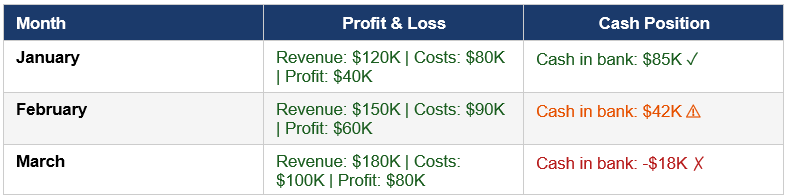
The business is more profitable than ever in March. And it's overdrawn.
This is the cash flow trap and it is most common in exactly the businesses that are growing fastest.
The Five Most Common Cash Flow Traps
Understanding why this happens is the first step to preventing it. Here are the five most common reasons growing businesses run into cash flow problems despite being profitable:
1. Slow-paying customers
Long payment terms — 30, 60, or 90 days — mean you're effectively financing your customers. The faster you grow, the bigger this gap becomes. A business doing $2M a year on 60-day terms has roughly $330K of its own money sitting in unpaid invoices at any given time.
2. Paying suppliers faster than you collect from customers
If your suppliers demand payment in 30 days but your customers pay in 60, you have a 30-day funding gap on every transaction. As revenue grows, so does the gap.
3. Growth requires cash before it generates cash
Hiring a new employee, taking on a bigger contract, buying equipment, or expanding into a new market all require upfront investment. The returns come later. Without visibility on this timing, growth can drain your cash reserves before the revenue catches up.
4. Seasonal patterns you haven't planned for
Many businesses have seasonal revenue but fixed monthly costs. If you don't plan for the quiet periods in advance, you'll run short on cash even in years where your annual profit looks healthy.
5. Loan repayments and tax obligations
Debt repayments and tax payments don't show up as expenses on your profit and loss statement but they absolutely affect your cash. A business can be profitable and still be caught short by a quarterly tax payment or a loan repayment it didn't plan around.
What You Can Do About It
The good news: cash flow problems are almost always preventable with the right financial visibility. Here's what that looks like in practice:
1. Build a rolling 13-week cash flow forecast
A 13-week forecast shows you exactly what cash is coming in and going out over the next quarter week by week. It gives you enough lead time to take action before a problem becomes a crisis. This is the single most valuable financial tool for any growing business, and most small businesses don't have one.
2. Understand your working capital cycle
Your working capital cycle is the time between spending money on your business and getting that money back from customers. The shorter it is, the healthier your cash position. Understanding it and actively managing it is one of the highest-impact things a finance function can do.
3. Tighten your AR process
Invoice promptly. Follow up on late payments systematically. Consider shorter payment terms for new customers. Every day you shave off your average collection time improves your cash position without changing your profitability at all.
4. Plan for lumpy expenses
Tax payments, loan repayments, insurance renewals, and equipment purchases are all foreseeable. Build them into your cash flow plan so they don't surprise you. A good finance function makes sure these never come as a shock.
5. Know your cash runway at all times
Cash runway is how long your business can operate at current spending levels if no new revenue comes in. Every business owner should know this number and it should inform every significant financial decision you make.
The Bottom Line
Profit tells you whether your business model works. Cash flow tells you whether your business survives.
Both matter. But in the short term, cash flow is the one that keeps the lights on.
The businesses that manage this well aren't the ones with the most sophisticated systems. They're the ones with clear financial visibility people who understand the difference, watch both numbers, and plan ahead. That's what good financial leadership gives you.
Not sure where your cash flow stands right now?
We help growing businesses build the cash flow visibility they need to make confident decisions before problems arise. Book a free 30-minute call and let's take a look at your numbers together.